GEO: How to Get Your Website Cited by AI Search Engines
70% of Google searches end without a click. Generative Engine Optimization (GEO) ensures that ChatGPT, Perplexity, and AI Overviews still recommend your website — with 7 actionable strategies.

Paul Mill
Web Design & Development

Table of contents
Imagine a potential customer asks ChatGPT: “Who does great web design in my area?” The AI responds — and your website isn’t mentioned. Not because it’s bad, but because the AI never saw it or didn’t know how to categorize your content.
This isn’t a future scenario. 70% of Google searches already end without a click — the answer appears directly in AI Overviews or an AI assistant. Gartner predicts a 25% decline in traditional search volume by the end of 2026. And brands cited in AI Overviews see up to 35% more clicks than non-cited results.
If you’re only doing traditional SEO today, you’re optimizing for a playing field that’s shrinking. Generative Engine Optimization (GEO) is the answer: preparing content so AI systems can find, understand, and cite it.
This article explains what GEO actually means, why it differs from traditional SEO — and shows seven measures you can implement right away.
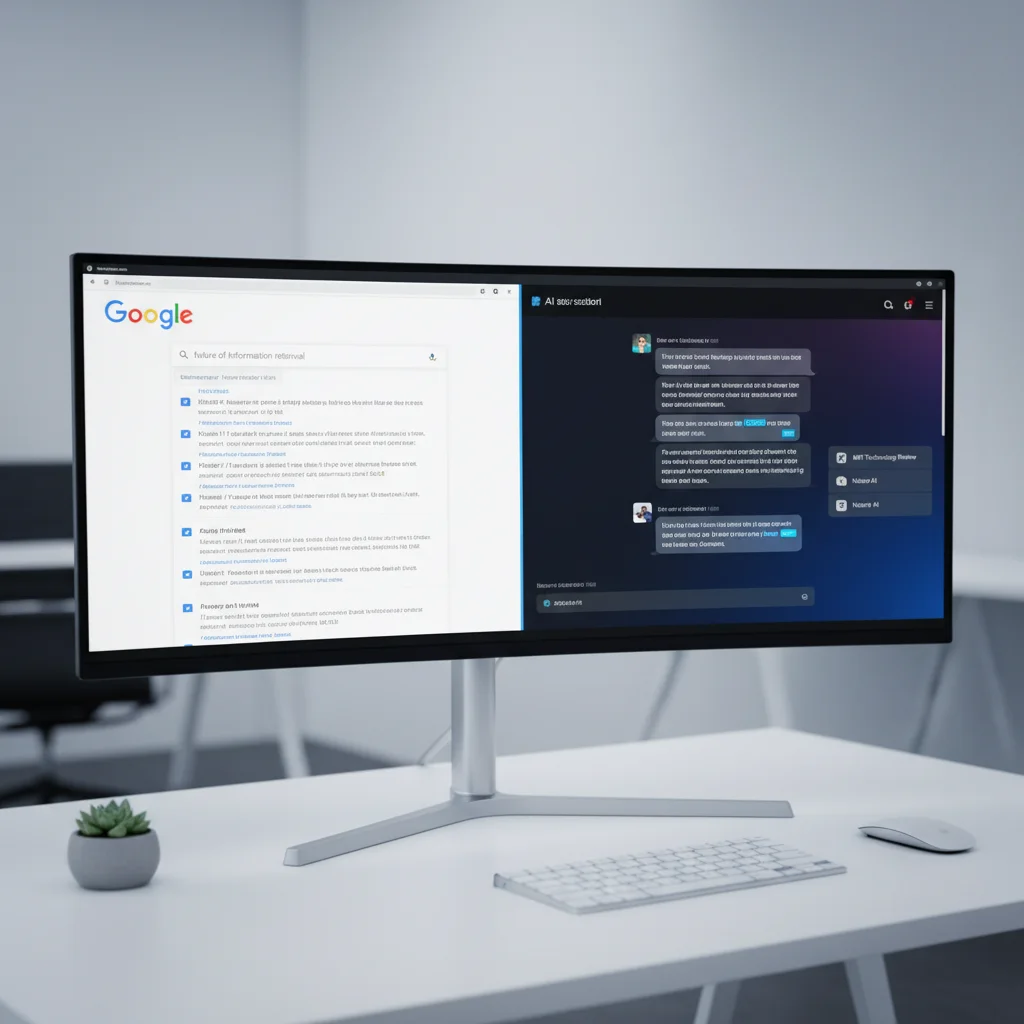
What Is GEO — and Why Isn’t SEO Enough Anymore?
SEO optimizes for Google’s index: crawling, indexing, rankings, clicks. That still works — but it only covers part of the search reality now.
GEO optimizes for a second layer: AI systems that read, summarize, and deliver content as answers. These include:
- Google AI Overviews — the AI summaries above organic results, now reaching over 2 billion monthly users
- ChatGPT with web search — OpenAI’s model searches the web and cites sources directly in its answers
- Perplexity — an AI search engine that provides sources for every answer
- Google Gemini — Google’s AI assistant with direct access to the search index
- Bing Copilot — Microsoft’s AI-powered search, integrated into Edge and Windows
The crucial difference: with traditional SEO, ranking on page 1 is enough. With GEO, your content must be citable — structured and authoritative enough that an AI selects it as a source.
An example: two websites rank for “improve Core Web Vitals” at positions 3 and 4. Both have good content. But only one gets cited in AI Overviews — because it provides clear definitions, structured data, and concrete numbers that the AI can extract as a trustworthy passage.
GEO vs. SEO: What Changes, What Stays
| Aspect | SEO | GEO |
|---|---|---|
| Goal | Ranking in search results | Citation by AI systems |
| Evaluation | PageRank, backlinks, keywords | Citability, authority, structure |
| Traffic model | Click on blue link | Brand mention in AI answer → indirect traffic |
| Technical | robots.txt, sitemap, meta tags | + AI crawler access, llms.txt, schema |
| Content | Keyword-optimized, comprehensive | + citable passages, clear definitions |
GEO doesn’t replace SEO — it extends it. If you’re doing good SEO today, you already have 70% of the GEO fundamentals covered. The remaining 30% is what this article is about.
Strategy 1: Grant AI Crawler Access
Before an AI can cite your content, it needs to be allowed to read it. Sounds obvious — it isn’t. Over 25% of top-1000 websites block at least one AI crawler in their robots.txt.
The most important AI crawlers and their user agents:
| AI System | Crawler | User Agent |
|---|---|---|
| OpenAI (ChatGPT) | GPTBot | GPTBot |
| Google (Gemini, AI Overviews) | Google-Extended | Google-Extended |
| Anthropic (Claude) | ClaudeBot | ClaudeBot |
| Perplexity | PerplexityBot | PerplexityBot |
| Meta (AI Training) | Meta-ExternalAgent | Meta-ExternalAgent |
| Microsoft (Copilot) | Bingbot | bingbot |
| Apple | Applebot | Applebot |
Check your robots.txt now. Open https://your-website.com/robots.txt and look for Disallow rules for these crawlers. If you’re blocking them, they can’t cite you — it’s that simple.
A clean robots.txt for GEO:
User-agent: *
Allow: /

User-agent: GPTBot
Allow: /

User-agent: ClaudeBot
Allow: /

User-agent: PerplexityBot
Allow: /

User-agent: Google-Extended
Allow: /

Sitemap: https://your-website.com/sitemap.xml
Cloudflare note: Since 2024, Cloudflare blocks AI bots by default via the “AI Bot Blocking” toggle in the dashboard. If you use Cloudflare, check under Security → Bots whether AI crawlers are being blocked — regardless of your robots.txt.
Strategy 2: Set Up llms.txt
llms.txt is a new standard that provides AI systems with a structured overview of your website — comparable to what robots.txt is for search engine crawlers. The file sits at your website’s root and explains in plain text what the site is about, which content matters, and how it connects.
# Paul Mill — Web Design & Performance

> Personal portfolio website of Paul Mill, specializing in
> performant websites, SEO optimization, and automation
> for small and medium businesses in the DACH region.

## Services
- [Web Design & Development](/leistungen/webdesign): Custom websites with Astro, Tailwind CSS, Cloudflare
- [Performance & SEO](/leistungen/performance): Core Web Vitals, technical SEO, conversion optimization
- [Automation](/leistungen/automatisierung): Workflow automation with n8n, API integrations, AI processes

## Blog
- [Core Web Vitals Guide](/blog/core-web-vitals-praxis): Practical guide for LCP, INP, CLS
- [Web Design Trends 2026](/blog/webdesign-trends-2026): CSS features, performance, accessibility
- [BFSG Checklist](/blog/bfsg-barrierefreiheit-website-checkliste): Accessibility for SMBs
The standard is supported by an increasing number of AI systems. llmstxt.org documents the specification. Major websites like Anthropic, Cloudflare, and Stripe have already implemented an llms.txt.
Tip: Also create an llms-full.txt with more detailed descriptions of each page — some AI systems prefer the detailed version.
Strategy 3: Write Citable Passages
AI systems don’t cite entire articles — they extract individual passages. Research from Georgia Tech and Princeton shows that certain text formats are cited significantly more often:
- Clear definitions at the beginning of a section: “Core Web Vitals are Google’s metrics for real-world user experience.”
- Statistics with source attribution: “43% of all websites fail the INP threshold of 200ms.”
- Structured lists with concrete action items
- Direct answers to common questions — in one sentence, not three paragraphs
The paper identifies five strategies that increase citation probability by 15–41%:
- Authoritative language — Write confidently and fact-based, not vaguely
- Include statistics — Numbers and data increase citability by 30%
- Source attribution — Links to reputable sources build AI trust
- Clear structure — H2/H3 hierarchy, short paragraphs, lists
- Simple language — Complex sentences are cited less often than concise statements
Practically: Write the first sentence of each section as if it were the only passage that gets cited. If that sentence makes sense on its own and makes a clear statement — you have a citable passage.
Comparison:
❌ “There are many different ways you can make your website faster, and a lot has changed in recent years.”
✅ “Three measures reliably reduce LCP by 1–2 seconds: WebP image format, fetchpriority on the hero image, and a CDN with sub-50ms TTFB.”
The second version gets cited. The first doesn’t.
Strategy 4: Schema Markup for AI Visibility
Structured data (Schema.org as JSON-LD) was already important for traditional SEO — for GEO it’s decisive. AI systems like Gemini and AI Overviews use schema data to verify and categorize content: Who wrote this article? When was it published? What organization does this person work for?
The most important schema types for GEO:
Article Schema (for blog posts)
{
  "@context": "https://schema.org",
  "@type": "Article",
  "headline": "GEO: How to Get Your Website Cited by AI Search Engines",
  "author": {
    "@type": "Person",
    "name": "Paul Mill",
    "url": "https://paulmill.com"
  },
  "datePublished": "2026-04-16",
  "dateModified": "2026-04-16",
  "publisher": {
    "@type": "Person",
    "name": "Paul Mill",
    "url": "https://paulmill.com"
  }
}
Organization/Person Schema (for the main page)
{
  "@context": "https://schema.org",
  "@type": "Person",
  "name": "Paul Mill",
  "url": "https://paulmill.com",
  "sameAs": [
    "https://www.linkedin.com/in/paulmill",
    "https://github.com/paulmill"
  ],
  "knowsAbout": ["Web Design", "SEO", "Core Web Vitals", "Automation"],
  "jobTitle": "Web Designer & SEO Expert"
}
Speakable Schema (new and GEO-relevant)
The speakable property marks passages that are especially suited for voice assistants and AI citations:
{
  "@type": "Article",
  "speakable": {
    "@type": "SpeakableSpecification",
    "cssSelector": [".article-summary", ".key-takeaway"]
  }
}
Google explicitly recommends speakable for content intended to be read aloud in Google Assistant and AI Overviews. Not widely adopted yet — but that’s exactly why it’s an advantage.
Important since January 2026: Google deprecated seven schema types, including HowTo and FAQPage for most websites. Focus on Article, Person, Organization, LocalBusiness, Product, and BreadcrumbList — these remain active and drive both rich results and AI citations.
Strategy 5: Strengthen E-E-A-T Signals
E-E-A-T stands for Experience, Expertise, Authoritativeness, Trustworthiness — and since the Google Core Update March 2026, it’s more important than ever, including for AI citations. AI systems prefer sources they can classify as trustworthy.
Concrete measures:
Make author profiles visible. Every article needs a visible author with name, photo, bio, and profile link. “Editorial team” or no author name at all signals to the AI: this source has no identifiable expertise.
Show experience, not just knowledge. The first “E” in E-E-A-T stands for Experience — direct experience. Instead of “It is recommended to use WebP images,” write: “In a recent project, converting hero images from PNG to WebP alone cut the LCP from 2.6s to 1.3s.” Experience reports are more valuable to AI systems than generic advice.
Link to reputable sources. Every statistic and every claim needs a source — ideally primary sources like Google documentation, studies, or official reports. AI systems check whether and where your external links point to.
Build brand mentions. AI systems use mentions of your brand on other websites to assess your authority. Guest articles, podcast appearances, directory listings, and social media presence feed into entity recognition — the AI’s knowledge of who you are and what you stand for.
Strategy 6: Structure Content for Zero-Click Search
70% of searches end without a click — but that doesn’t mean you get no traffic. It means the traffic path changes: from “click on blue link” to “AI names your brand → user searches directly for you.”
Three strategies for this new reality:
Use question-answer structure. Frame subheadings as questions real users ask. Answer them directly and concisely in the first sentence. This is the format AI Overviews extract most frequently.
Place summaries at the beginning. A 2–3 sentence summary under the main heading gives AI systems the condensed statement they use as a citation. Like an abstract in an academic paper.
Include tables and comparisons. Structured formats like tables, bullet lists, and comparison matrices are disproportionately included in AI answers. Our Core Web Vitals guide uses exactly this format — with threshold tables and prioritized action lists.
Brand name in key statements. When an AI cites your passage, it’s only valuable if your name is included. Instead of “It’s recommended to convert images to WebP,” write: “In my projects at paulmill.com, I convert hero images to WebP as standard — this reliably halves the LCP.” The AI cites the passage including the brand name.
Strategy 7: Measure AI Visibility
GEO optimization without measurement is flying blind. Unlike traditional SEO, there are no unified tools yet — but the data landscape is improving rapidly.
What You Can Measure Today
Google Search Console → AI Overviews. Since 2025, Search Console shows which queries your page appears in AI Overviews for. Under “Performance” → Appearance filter → “AI Overview.” This is your most important GEO KPI.
Referral traffic from AI sources. Check your analytics (Google Analytics, Plausible, Fathom) for referral sources. Traffic from chat.openai.com, perplexity.ai, or gemini.google.com shows that AI systems are citing you and users are clicking through.
Track brand searches. An increase in searches for your brand name is a strong signal: users saw you in an AI answer and are searching specifically for you. Search Console shows this under “Performance” → filter for your brand name.
Manual AI checks. Ask ChatGPT, Perplexity, and Gemini the questions you want to rank for: “Who does great web design in Göttingen?” — “How do I improve Core Web Vitals?” — “What does a professional website cost?” Check if and how you’re cited.
Tools for GEO Analysis
| Tool | What it measures | Price |
|---|---|---|
| Google Search Console | AI Overview impressions, CTR | Free |
| Semrush | AI Overview tracking, position | From $139/month |
| Ahrefs | AI mentions, brand mentions | From $129/month |
| Otterly.ai | AI citations across platforms | From $25/month |
| Perplexity Analytics | Publisher dashboard for citations | Free (Beta) |
Frequently Asked Questions About GEO
Do I need GEO if my traditional SEO is working well?
Yes — because the share of zero-click searches is rising. Today it’s 70%, trending upward. Even if your organic traffic is stable, you’re losing potential visibility that a competitor is capturing through AI citations. GEO isn’t a replacement for SEO, but an extension.
Is GEO only relevant for large businesses?
No — GEO is especially an opportunity for SMBs. Large companies have brand recognition that AI systems already know. Small businesses need to actively ensure AI systems recognize them as an entity. Schema markup, llms.txt, and consistent brand mentions are the levers that make this possible — and they cost nothing but time.
Can I implement GEO myself or do I need an expert?
The technical measures (robots.txt, llms.txt, schema markup) are doable in 2–3 hours with basic knowledge. The content strategy — writing citable passages, building E-E-A-T, generating brand mentions — requires ongoing work and experience. Like SEO: you can handle the basics yourself, but professional support pays off for the strategy.
How quickly will I see results?
Technical changes (crawler access, llms.txt, schema) take effect within 2–4 weeks, once AI crawlers re-index the site. Content optimizations need 4–8 weeks. Brand mentions and authority building are a long-term project — expect 3–6 months for measurable results in AI citations.
What Remains
GEO isn’t a marketing buzzword — it’s the logical consequence of how people find information changing. When 70% of searches end without a click and AI assistants become the first point of contact, your content doesn’t just need to be rankable — it needs to be citable.
The seven strategies in this article — from AI crawler access through llms.txt and citable passages to schema markup and brand mentions — aren’t a theoretical framework. They’re concrete steps you can implement this week.
The common thread: Make it easy for AI to understand you. Structured data, clear statements, verifiable sources, visible authorship. That’s not just good for AI search engines — it’s good for every reader.
If you want to know how visible your website is to AI systems, check out my Performance & SEO offering — or get in touch for an initial, no-obligation assessment of your project.